


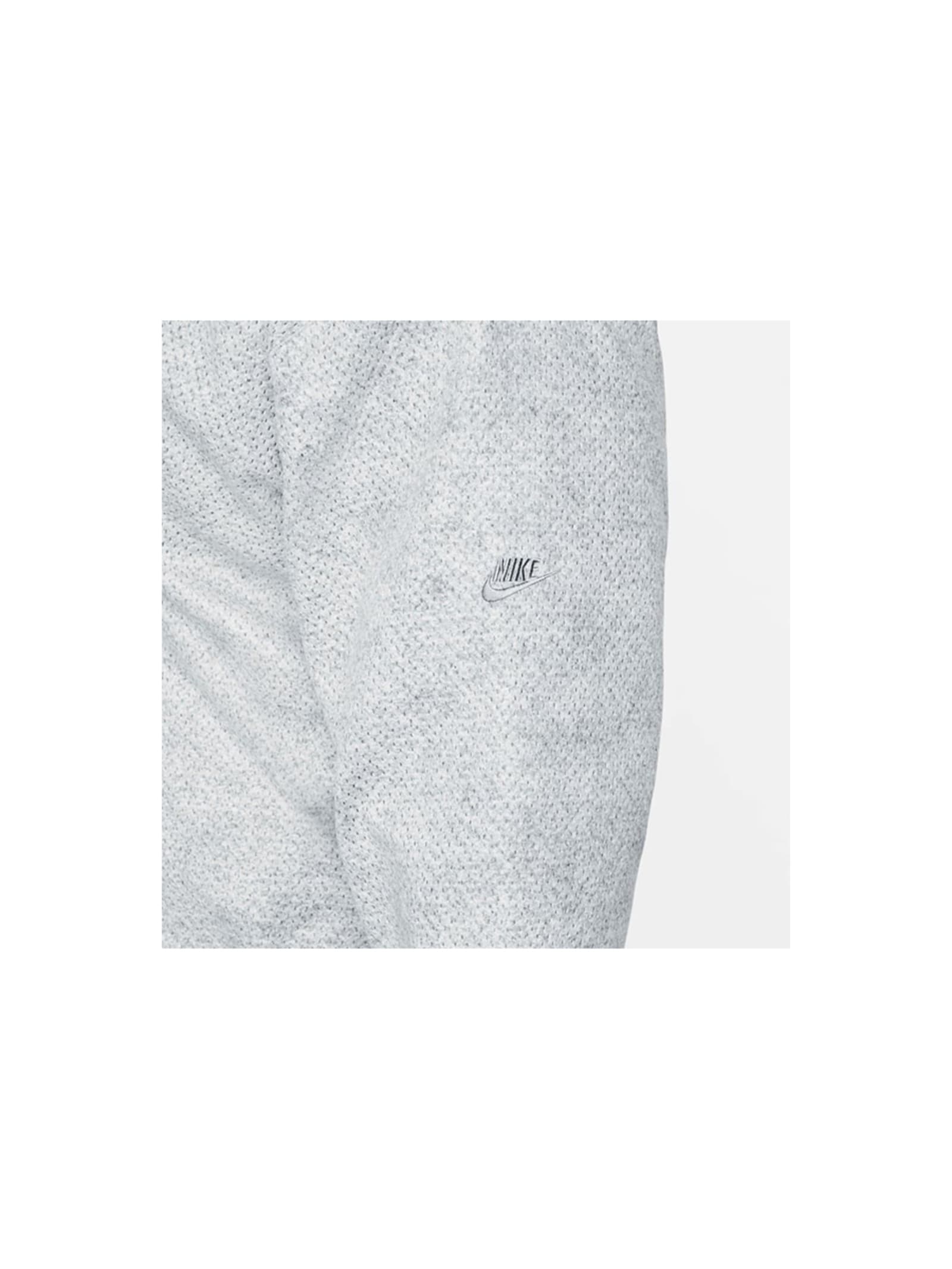

Forward Hoodie / Nike
The Forward Hoodie is really a vehicle for its material. Nike Forward is made not by knitting or weaving but by needle-punching ultra-thin layers of fibre directly into a textile, a non-woven process borrowed from industrial and medical manufacturing that skips spinning yarn and several other steps. The result is softer to the hand, warmer per gram, around 70% recycled polyester, and roughly 75% lower in production carbon on average than Nike's traditional knit fleece. The hoodie itself is deliberately plain: a standard cut, a kangaroo pocket, and no zip or extra trims. The understatement is the point, since the whole story is tactile and technical rather than visual. Built without zips or aglets, it can be shredded and fed back into the same needle-punching machine at end of life.
Design intent
- +Needle-punching fibre straight into fabric traps air differently from woven fleece, giving more warmth at lower weight; it is a materials decision you feel directly in the wearing.
- +Leaving out the zip and trims is a circularity choice as much as an aesthetic one: a single-material garment can be shredded and its fibre reused rather than landfilled.
Trade-offs
- -The non-woven structure snags and pills more readily than tightly woven fleece; it rewards managed wear and degrades faster under rough use.
- -Its headline gain is the production carbon figure; a wearer who does not weight that is paying for a material difference more felt than seen.
Related products







The Forward Hoodie is really a vehicle for its material. Nike Forward is made not by knitting or weaving but by needle-punching ultra-thin layers of fibre directly into a textile, a non-woven process borrowed from industrial and medical manufacturing that skips spinning yarn and several other steps. The result is softer to the hand, warmer per gram, around 70% recycled polyester, and roughly 75% lower in production carbon on average than Nike's traditional knit fleece. The hoodie itself is deliberately plain: a standard cut, a kangaroo pocket, and no zip or extra trims. The understatement is the point, since the whole story is tactile and technical rather than visual. Built without zips or aglets, it can be shredded and fed back into the same needle-punching machine at end of life.
Design intent
- +Needle-punching fibre straight into fabric traps air differently from woven fleece, giving more warmth at lower weight; it is a materials decision you feel directly in the wearing.
- +Leaving out the zip and trims is a circularity choice as much as an aesthetic one: a single-material garment can be shredded and its fibre reused rather than landfilled.
Trade-offs
- -The non-woven structure snags and pills more readily than tightly woven fleece; it rewards managed wear and degrades faster under rough use.
- -Its headline gain is the production carbon figure; a wearer who does not weight that is paying for a material difference more felt than seen.
Source
Year
Tags
Indexed
5 Jun 2023