Manhattan Cocktail Shaker / Georg Jensen
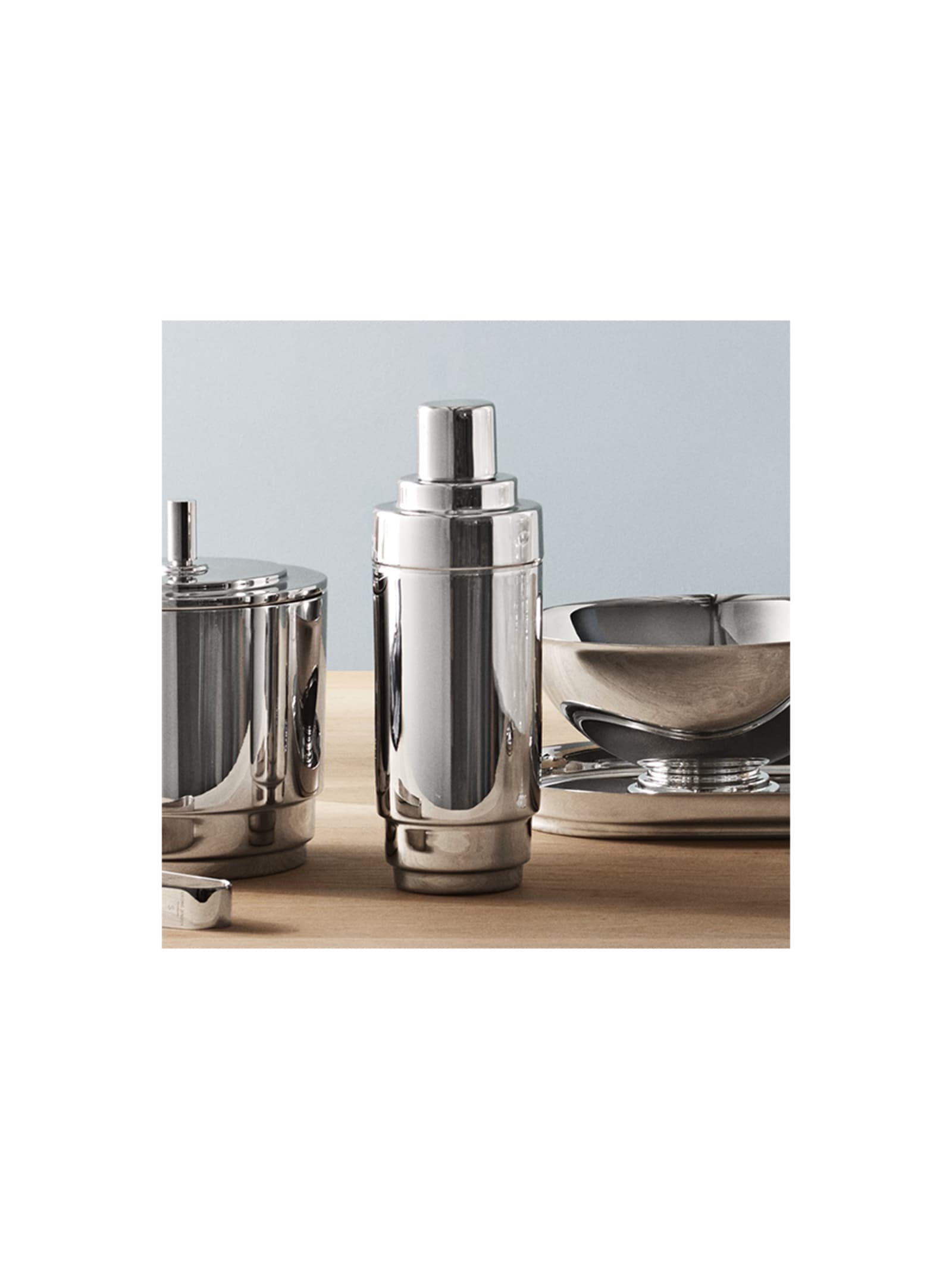
The Manhattan is Georg Jensen's bar collection rendered in mirror-polished stainless steel, and the cocktail shaker is its clearest statement: a three-piece form roughly 200mm tall, with the rigid geometric lines the brand drew from New York Art Deco and its own archive. There is no named designer and no mechanism to admire. What it offers instead is proportion and finish: a tapered body, a tight-seating cap and strainer, and a high-shine surface the whole object is built to carry. It holds around 0.75 litres, enough for several drinks at once. This is barware chosen for presence on a back bar or a side table rather than for any technical advantage over a cheaper shaker, and it is honest about that.
Design intent
- +The form is the product: with no working parts to express, the design invests in proportion, the geometry of the taper and a mirror finish that reads as the object's entire argument.
- +Three-piece construction with a built-in strainer keeps the shaker a single coherent volume, so the Art Deco styling and the practical job of straining a drink occupy the same body.
Trade-offs
- -The mirror polish shows fingerprints, water spots and fine scratches almost immediately, and looks its best only when wiped clean rather than carried hard.
- -It carries a design-brand premium over shakers that pour and strain just as well, so the cost reflects finish and provenance rather than any functional gain.
Related products
)
)






The Manhattan is Georg Jensen's bar collection rendered in mirror-polished stainless steel, and the cocktail shaker is its clearest statement: a three-piece form roughly 200mm tall, with the rigid geometric lines the brand drew from New York Art Deco and its own archive. There is no named designer and no mechanism to admire. What it offers instead is proportion and finish: a tapered body, a tight-seating cap and strainer, and a high-shine surface the whole object is built to carry. It holds around 0.75 litres, enough for several drinks at once. This is barware chosen for presence on a back bar or a side table rather than for any technical advantage over a cheaper shaker, and it is honest about that.
Design intent
- +The form is the product: with no working parts to express, the design invests in proportion, the geometry of the taper and a mirror finish that reads as the object's entire argument.
- +Three-piece construction with a built-in strainer keeps the shaker a single coherent volume, so the Art Deco styling and the practical job of straining a drink occupy the same body.
Trade-offs
- -The mirror polish shows fingerprints, water spots and fine scratches almost immediately, and looks its best only when wiped clean rather than carried hard.
- -It carries a design-brand premium over shakers that pour and strain just as well, so the cost reflects finish and provenance rather than any functional gain.