
Max Bill Automatic / Junghans
/ / / /
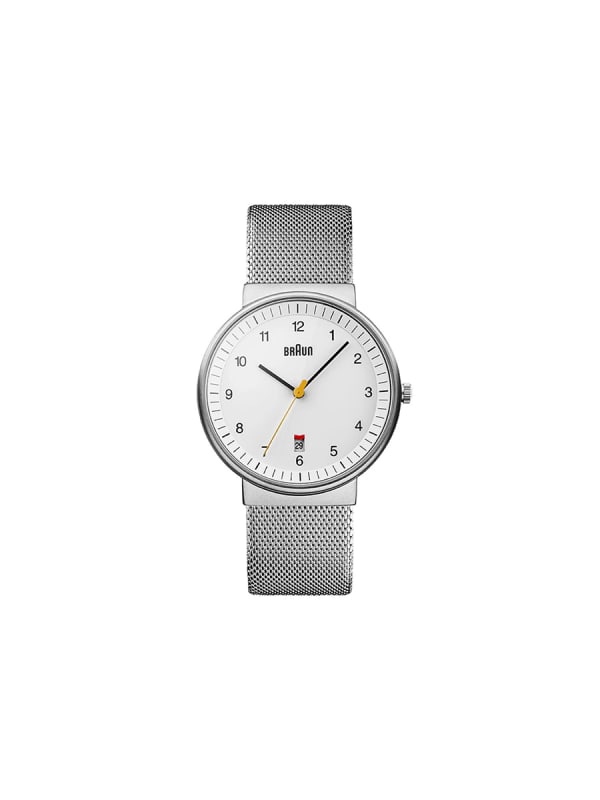
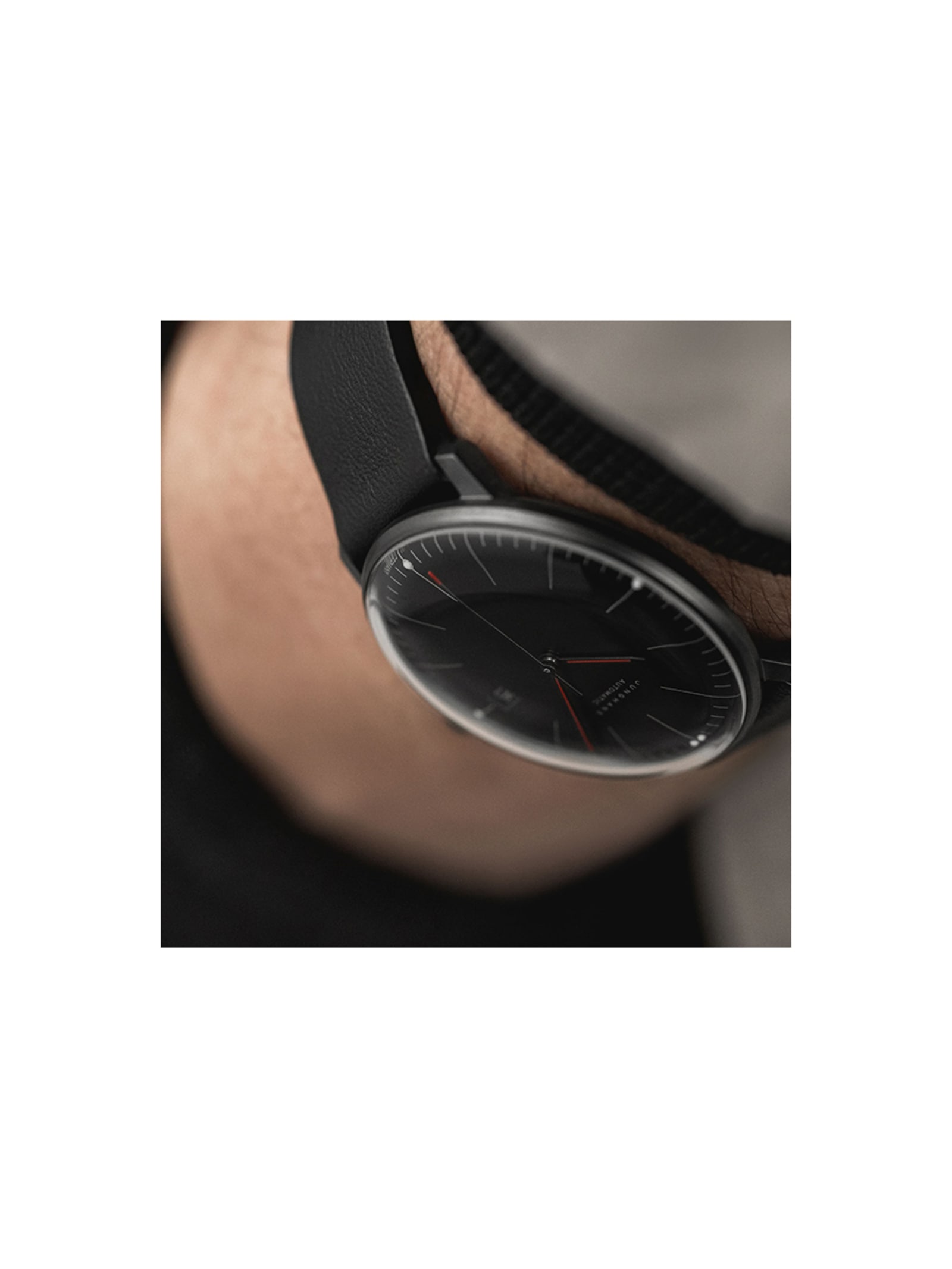
The Max Bill Automatic puts one of the clearest Bauhaus dials ever drawn onto a self-winding movement. Max Bill, the Swiss artist and architect who trained at the Bauhaus, designed the watch for Junghans in the early 1960s, and the current version keeps his decisions intact: slim Arabic numerals or plain indices, narrow well-proportioned hands, and a domed plexiglass crystal that softens the light across the dial. The case is 38mm of stainless steel, around 10mm thick, so it sits flat under a cuff. Inside is the J800.1, an automatic movement based on the ETA 2824-2 with a power reserve of roughly 38 hours. It is offered on a calf leather strap or a Milanese bracelet. The watch does one thing, legibly, and resists adding anything to it.
Design intent
- Bill tuned every dial element for reading speed: the numerals, the index lengths and the hand proportions are sized so the time registers at a glance, which is the whole purpose of the design.
- The domed plexiglass crystal is a deliberate period-correct choice over sapphire, giving the dial its characteristic softness and staying faithful to the early-1960s original.
Trade-offs
- Plexiglass scratches far more easily than sapphire, so the crystal marks with everyday wear, though it can be polished back.
- The dial's restraint can read as plain beside watches at the price that offer more visible movement finishing or complication.
- Source
- Year
- Category
- / /
- Colour
- Material
- Indexed
- 22 May 2023